
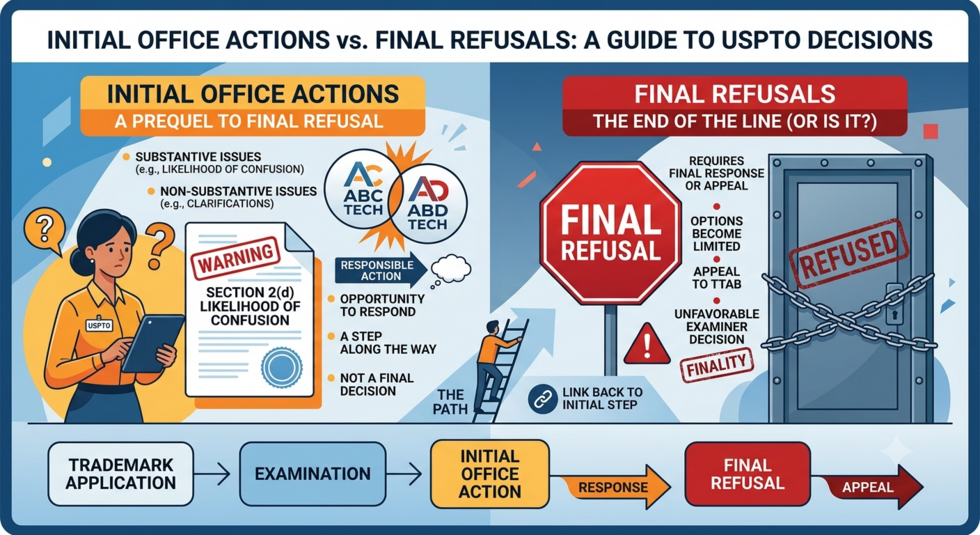
USPTO Office Actions Explained: Initial vs. Final Refusals
Quick answer: A USPTO Office Action is an official letter identifying problems with your trademark application. Initial Office Actions—either non-substantive (minor formalities) or substantive (like Section 2(d) Likelihood of Confusion refusals)—require a timely written response. Failing to respond adequately can result in a Final Refusal, which significantly limits your options.
Filing a trademark application feels like progress. You've chosen your mark, completed the forms, paid the fees, and submitted everything to the United States Patent and Trademark Office (USPTO). Then, weeks or months later, an Office Action lands in your inbox—and suddenly the process feels a lot more complicated.
Office Actions are common. According to the USPTO, a significant portion of trademark applications receive at least one Office Action before registration is approved. For many applicants, receiving one comes as a surprise. Understanding what type of Office Action you've received, why it was issued, and how to respond are the three most important things you can do to protect your trademark rights.
This guide breaks down the two main categories of Office Actions—non-substantive and substantive—explains the difference between an initial and a final refusal, and walks you through what happens if you don't respond in time. Whether you're handling the process yourself or working with a trademark attorney, knowing what you're dealing with is the first step toward a successful outcome.
What Is a USPTO Office Action?
A USPTO Office Action is a formal written communication from an examining attorney at the USPTO. It is issued when the examiner identifies one or more issues that prevent your trademark application from moving forward toward publication or registration.
Office Actions are not automatic rejections. They are, in most cases, an opportunity to correct problems—either administrative or legal—before the application is abandoned. You typically have three months from the date of the Office Action to respond (extendable to six months for a fee).
Office Actions fall into two broad categories: non-substantive and substantive.
Non-Substantive Office Actions: Minor Issues That Still Require Attention
Non-substantive Office Actions address procedural or technical deficiencies in your application. These are generally easier to resolve than substantive refusals, but they still require a formal written response within the deadline.
What are common examples of non-substantive Office Actions?
Common issues raised in non-substantive Office Actions include:
- Identification of goods/services: The description of what your mark covers is too vague, too broad, or uses language the USPTO does not accept. For example, describing your goods as "clothing" may need to be refined to "t-shirts, jackets, and hats."
- Specimen issues: The sample you submitted to show how you use the mark in commerce does not meet USPTO requirements. A screenshot of a social media profile, for example, may be rejected if it does not clearly show the mark being used in connection with the goods or services.
- Disclaimer requirement: Certain descriptive or generic words within your mark may need to be disclaimed—meaning you acknowledge you're not claiming exclusive rights to that word alone.
- Entity or domicile issues: The USPTO now requires foreign-domiciled applicants to be represented by a U.S.-licensed attorney, and domestic applicants must provide a valid U.S. domicile address.
- Signature deficiencies: The application was not properly signed by the appropriate party.
These issues can often be resolved with a straightforward response—correcting the description, submitting a new specimen, or providing the required information. However, underestimating them is a mistake. An inadequate response, or no response at all, puts your application at risk of abandonment.
Substantive Office Actions: When the USPTO Challenges Your Mark on Legal Grounds
Substantive Office Actions raise legal grounds for refusing registration. These require more strategic, detailed responses and often benefit from the involvement of a trademark attorney.
What is a Section 2(d) Likelihood of Confusion refusal?
The most common substantive refusal is a Section 2(d) Likelihood of Confusion refusal, issued under Section 2(d) of the Lanham Act. The USPTO examining attorney refuses registration on the grounds that your mark is likely to be confused with one or more previously registered marks.
The examiner applies a multi-factor test (commonly known as the DuPont factors) to assess the likelihood of confusion. The two most heavily weighted factors are:
- The similarity of the marks — Are the marks similar in appearance, sound, meaning, or commercial impression?
- The relatedness of the goods/services — Do the goods or services travel in the same channels of trade and reach the same types of consumers?
A Section 2(d) refusal does not mean your application is dead. It means the examining attorney has found a conflict that must be addressed. Possible responses include:
- Arguing the marks are not confusingly similar — by analyzing the marks' visual, phonetic, and conceptual differences
- Arguing the goods/services are distinct — by demonstrating that the respective offerings target different markets or move through different trade channels
- Submitting evidence of coexistence — such as evidence that both marks have operated in the market simultaneously without actual consumer confusion
- Amending the identification of goods/services to narrow the scope of coverage and distinguish it from the cited mark
- Pursuing a consent agreement with the owner of the cited mark
What are other types of substantive Office Actions?
Beyond Section 2(d) refusals, examining attorneys may issue substantive refusals on other grounds, including:
- Section 2(e)(1) — Merely Descriptive: The mark directly describes a feature, quality, or characteristic of the goods/services (e.g., "COLD AND CREAMY" for ice cream).
- Section 2(e)(3) — Primarily Geographically Descriptive: The mark primarily refers to a geographic location associated with the goods/services.
- Primarily Merely a Surname: The mark is primarily perceived as a last name rather than a brand identifier.
- Ornamental refusal: The mark, as applied to goods, is perceived as decorative rather than as a source identifier.
Each of these refusals has its own legal framework and requires a tailored response strategy.
How to Respond to an Initial Office Action
When you receive an initial Office Action, the clock starts. The USPTO sets a three-month response deadline from the date of the Office Action, with the option to extend that deadline up to six months by paying an extension fee. Missing the final deadline entirely results in abandonment of your application.
What should a response to a USPTO Office Action include?
Your response must directly address every issue raised in the Office Action. Failing to respond to even one point—even a seemingly minor one—can result in that issue becoming final in a subsequent Office Action.
For non-substantive issues, your response may include:
- Amended identification of goods/services language
- A substitute specimen with a declaration of use
- Updated applicant information or signatures
For substantive issues like a Section 2(d) refusal, a persuasive response typically includes:
- A legal argument analyzing the relevant DuPont factors
- Supporting evidence (third-party registrations, market research, declarations)
- Any proposed amendments to the application
The quality of this response matters enormously. An examining attorney who is not persuaded by your initial response may issue a Final Office Action—and at that point, your options narrow significantly.
What Happens If You Don't Respond — The Path to a Final Refusal
If you fail to respond to an initial Office Action by the deadline, the USPTO will issue a Notice of Abandonment. Your application is considered abandoned, and you lose the filing date and any priority rights associated with it.
If you respond but the examining attorney is not persuaded, a Final Office Action will be issued. A Final Office Action, also called a final refusal, signals that the examiner has maintained their position after considering your arguments.
How is a Final Office Action different from an initial Office Action?
An initial Office Action is the examiner's first substantive assessment of your application. You have the opportunity to respond, argue, and provide evidence. A Final Office Action means the examiner has reviewed your response and still refuses registration.
At the final refusal stage, your standard response options are more limited. You cannot simply re-argue the same points. From here, your primary options include:
- Filing a Request for Reconsideration — submitting new arguments or evidence that directly addresses the examiner's final reasoning
- Filing a Notice of Appeal to the Trademark Trial and Appeal Board (TTAB)
- Allowing the application to go abandoned
The TTAB appeal process introduces a separate, more formal set of procedures, deadlines, and legal standards. At this stage, professional legal representation becomes especially important.
Why Acting Early Is Your Best Protection
The difference between a resolved trademark application and an abandoned one often comes down to one thing: how quickly and thoroughly an applicant responds to early Office Actions.
Non-substantive issues left unaddressed become final. Substantive refusals met with generic arguments rarely succeed. And every missed deadline moves the application one step closer to abandonment—erasing the filing date, priority rights, and registration momentum you've already built.
Receiving an Office Action is not the end of the road. For most applicants, it is a normal part of the process. The key is treating it with the seriousness it deserves. If you receive an Office Action and are uncertain how to respond—particularly in the case of a Section 2(d) Likelihood of Confusion refusal—consulting with a trademark attorney early gives you the best chance of keeping your application alive.
Frequently Asked Questions
What is the difference between a non-substantive and a substantive Office Action?
A non-substantive Office Action raises procedural or technical issues—like an unclear description of goods or an improper specimen. A substantive Office Action raises legal grounds for refusal, such as a likelihood of confusion with an existing mark or a finding that the mark is merely descriptive.
How long do I have to respond to a USPTO Office Action?
You have three months from the issue date of the Office Action. You can extend this to six months by paying a per-month extension fee. Missing the six-month deadline results in abandonment of your application.
What happens if I receive a Section 2(d) Likelihood of Confusion refusal?
The USPTO examining attorney has found your mark likely to be confused with an existing registered mark. You can respond by arguing that the marks are not confusingly similar, that the goods/services are distinct, or by submitting supporting evidence. A well-crafted response can overcome this refusal, but it typically requires detailed legal argument.
Can I respond to a Final Office Action?
Yes, but your options are more limited than at the initial stage. You may file a Request for Reconsideration with new evidence or arguments, or you may appeal the decision to the Trademark Trial and Appeal Board (TTAB).
Should I hire a trademark attorney to respond to an Office Action?
While it is possible to respond on your own, substantive Office Actions—especially Section 2(d) refusals—often require legal analysis and persuasive argumentation. A trademark attorney can assess the strength of your position, craft a targeted response, and help you avoid common mistakes that lead to final refusals.
What is a Notice of Abandonment?
A Notice of Abandonment is issued by the USPTO when an applicant fails to respond to an Office Action within the required timeframe. Once abandoned, the application cannot be revived in most cases, and the applicant loses their filing date and priority rights.

