
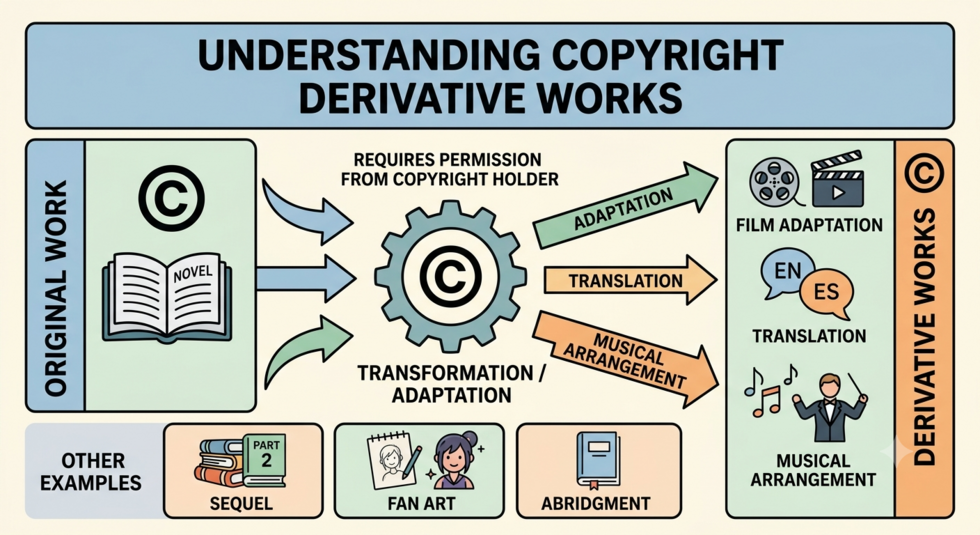
What Counts as a Derivative Work Under Copyright Law?
Quick answer: A derivative work is a new creation based on one or more pre-existing copyrighted works. To qualify as lawful, it must either obtain permission from the original copyright holder or fall within a recognized legal exception, such as fair use. Unauthorized derivative works can expose creators to significant copyright infringement liability.
Copyright law protects original works of authorship—but what happens when a new work builds or expands on an existing one? A film adapted from a novel, a translated book, a remixed song, or an artwork reimagined in a new medium: each of these raises a fundamental legal question. Does this new creation constitute a derivative work, and if so, who has the right to make it?
The answer matters enormously. Creators, publishers, developers, and businesses who get this wrong can face substantial infringement claims. Understanding what the law considers a derivative work—and what rights attach to it—is essential for anyone working with creative content.
What Is a Derivative Work Under U.S. Copyright Law?
Under the U.S. Copyright Act (17 U.S.C. § 101), a derivative work is defined as "a work based upon one or more preexisting works." The statute provides a non-exhaustive list of examples, including translations, musical arrangements, dramatizations, fictionalizations, motion picture versions, sound recordings, abridgments, and condensations.
The key legal threshold is whether the new work incorporates, transforms, or adapts protectable expression from the underlying work—not merely its ideas, facts, or style. Copyright protects expression, not ideas. This distinction, known as the idea-expression dichotomy, is foundational to derivative work analysis.
For a derivative work to receive its own copyright protection, it must contain a sufficient amount of original creative expression added by the new author. The derivative work copyright, however, only covers that newly added material—it does not extend to or affect the copyright in the underlying work.
What Are Common Examples of Derivative Works?
Derivative works appear across virtually every creative industry. Common examples recognized under copyright law include:
- Literary adaptations: A screenplay written from a novel, or an abridged version of a book
- Translations: Converting a work from one language to another
- Musical arrangements: Rearranging an existing composition for a different instrument or ensemble
- Sequels and prequels: New works that continue or expand upon characters or storylines from a copyrighted original
- Artwork reproductions with modifications: A painting reproduced with alterations or overlays
- Software modifications: New code built upon a proprietary codebase
- AI-generated content based on copyrighted inputs: An increasingly contested area that courts and the Copyright Office continue to examine
This last category—AI-generated derivative works—has emerged as one of the most legally uncertain areas in copyright today, with active litigation and regulatory scrutiny underway in the United States.
Who Has the Right to Create a Derivative Work?
Under 17 U.S.C. § 106(2), the exclusive right to prepare derivative works belongs to the copyright owner of the underlying work. This means that creating a derivative work without authorization from the copyright holder constitutes infringement—unless a specific legal exception applies.
There are two primary routes to lawfully creating a derivative work:
1. Obtaining a license: The creator secures written permission from the copyright owner, typically through a licensing agreement that specifies the scope of permitted uses.
2. Qualifying under fair use: Under 17 U.S.C. § 107, certain uses of copyrighted material may be permissible without a license. Courts apply a four-factor balancing test to assess fair use claims:
- The purpose and character of the use (commercial vs. educational; transformative vs. reproductive)
- The nature of the copyrighted work
- The amount and substantiality of the portion used
- The effect of the use on the potential market for the original work
Transformation is a particularly significant factor. A use that adds new meaning, commentary, or expression—rather than simply reproducing the original—is more likely to qualify as fair use. However, fair use is a fact-specific inquiry decided case by case, and relying on it without legal counsel carries meaningful risk.
How Do Courts Determine Whether a Work Is "Sufficiently Transformative"?
Transformation is central to many derivative work disputes. The U.S. Supreme Court addressed this directly in Campbell v. Acuff-Rose Music, Inc., 510 U.S. 569 (1994), holding that parody that comments on the original work can qualify as fair use, even when it copies recognizable elements from that work.
More recently, in Andy Warhol Foundation for the Visual Arts, Inc. v. Goldsmith, 598 U.S. 508 (2023), the Supreme Court clarified that commercial transformation must go beyond aesthetic change. The Court held that Warhol's use of a Lynn Goldsmith photograph of Prince—repurposed for a magazine license—was not protected by fair use, because the use served a substantially similar commercial purpose as the original photograph.
The Warhol decision has significant implications: courts will scrutinize the purpose and market function of a derivative work, not merely its visual or stylistic differences from the original.
What Happens If a Derivative Work Is Created Without Permission?
Unauthorized creation of a derivative work constitutes copyright infringement. The copyright owner may pursue remedies including:
- Actual damages and lost profits attributable to the infringement
- Statutory damages ranging from $750 to $30,000 per work (and up to $150,000 for willful infringement) under 17 U.S.C. § 504
- Injunctive relief to stop further distribution or use of the infringing work
- Attorney's fees in certain circumstances
It is worth noting that even an infringing derivative work may contain independently copyrightable elements. However, the infringer cannot enforce that copyright without addressing the underlying infringement.
What Should Creators and Businesses Do Before Building on Existing Works?
Anyone seeking to create a work based on existing copyrighted content should take several practical steps:
- Identify the copyright owner and determine whether the work is still under copyright protection or has entered the public domain
- Obtain a written license that clearly defines the permitted scope of use, territory, duration, and exclusivity
- Document all permissions and maintain records of licensing agreements
- Consult copyright counsel before proceeding if there is any uncertainty about fair use or the scope of an existing license
- Conduct a clearance review for works that will be commercially published or distributed
These steps are not merely procedural—they are the foundation of a sound risk management strategy.
The Bottom Line on Derivative Works and Copyright Protection
The line between inspiration and infringement is not always obvious, but copyright law provides a structured framework for analyzing it. A derivative work incorporates protectable expression from an existing copyrighted work and requires either a license or a valid legal defense to be lawful.
As creative industries evolve—particularly with the rise of AI-generated content and digital remixing—derivative work questions are arising in new and complex contexts. Staying legally compliant requires more than general awareness; it requires applying the law carefully to each specific situation.
If you are developing a project that builds on existing creative works, speaking with an experienced copyright attorney before proceeding can prevent costly disputes down the line.
Frequently Asked Questions About Derivative Works
What makes something a derivative work and not an original work?
A work is derivative when it incorporates or adapts protectable expression from a pre-existing copyrighted work. An original work, by contrast, contains expression that originates independently with the author and meets a minimal threshold of creativity. The two categories are not mutually exclusive—a derivative work can also contain original elements authored by the new creator.
Does a derivative work need to be registered to be protected?
Copyright protection in the United States arises automatically upon creation and fixation in a tangible medium. However, registration with the U.S. Copyright Office is required before filing an infringement lawsuit and is necessary to be eligible for statutory damages and attorney's fees.
Can a public domain work be used to create a derivative work freely?
Yes. Works in the public domain are no longer protected by copyright, and anyone may freely create derivative works from them. However, care must be taken to ensure the underlying work is genuinely in the public domain, as copyright terms vary depending on the date of publication and other factors.
Is fan fiction considered a derivative work?
Fan fiction that uses copyrighted characters, settings, or storylines from existing works is generally considered a derivative work. Whether it constitutes infringement depends on factors including the degree of copying, the commercial nature of the fan work, and the copyright owner's enforcement practices. Non-commercial fan fiction has historically been tolerated by many rights holders, but it does not carry a legal exemption.
Does using only a small portion of a copyrighted work make a derivative work permissible?
Not necessarily. The amount used is only one factor in the fair use analysis. Courts also consider whether the portion used was the "heart" of the original work—a brief but highly distinctive excerpt can still constitute actionable infringement.

