
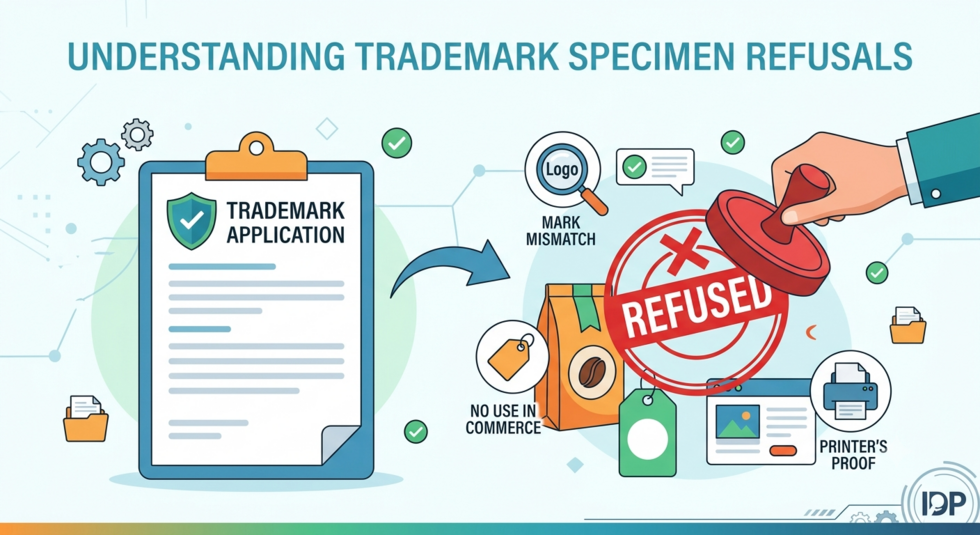
Trademark Application Rejected? Your Specimen May Be the Problem
In the United States, trademark rights exist upon actual use in commerce of a mark. A specimen is proof that your trademark is actively used in commerce. The USPTO requires a specimen with every trademark application that is based on commercial usage in the US, and specimen errors are among the most common reasons for office actions (ie., refusals). Understanding what qualifies - and what doesn't - can mean the difference between a smooth registration and costly delays.
Trademark registration is rarely as straightforward as it seems. You've selected a strong mark, conducted a clearance search, and submitted your application—only to receive an office action from the United States Patent and Trademark Office (USPTO) flagging your specimen. It's a frustrating setback, but it's also a common one.
Specimen issues account for a significant portion of USPTO office actions. The good news: most are avoidable with the right preparation. This article walks through the most frequent specimen problems that arise during trademark prosecution, why they matter, and how to address them before they derail your application.
What Is a Trademark Specimen, and Why Does the USPTO Require One?
A specimen is a real-world example showing that your trademark is actually being used in commerce—not just registered in theory. The USPTO requires specimens to ensure that trademark protection is granted only to marks that are genuinely functioning in the marketplace.
For goods-based applications filed under Sections 1(a) (use in commerce) or 44, specimens must show the mark as it appears on the actual goods, their packaging, or associated displays. For services, specimens must demonstrate the mark being used in the sale or advertising of those services. The standards differ meaningfully between the two, which is a source of confusion for many applicants.
If you are filing your trademark application on the basis of existing use in commerce, you will need to provide a specimen for each class of goods or services at the time of the application.
A specimen is also required when you are filing a Statement of Use to convert an "intent-to-use" application into one based on use. For more information on the Statement of Use, check out our blog article! https://www.iveticlaw.com/trademark-registration-what-is-a-statement-of-use-and-when-do-you-need-to-file-one
Even after you register your federal trademark, you will need to continue to provide specimens proving use when you file renewal documentation, such as the Section 8 or Section 9 declarations. For more information on renewal of your federal trademark registration, see our other blog article on that topic! https://www.iveticlaw.com/if-i-register-a-trademark-do-i-own-it-forever
The Most Common Specimen Problems in Trademark Applications
Does the Specimen Show the Mark Being Used "In Commerce"?
One of the most frequent refusals involves specimens that fail to demonstrate use in commerce as defined by the Lanham Act. Commerce, in this context, refers to trade that can be lawfully regulated by Congress—typically interstate or international commerce.
A mock-up, draft, or prototype of a product label does not satisfy this requirement. The specimen must reflect actual commercial use. For goods, this means the mark appears on the product itself, its packaging, tags, or labels at the point of sale. For services, acceptable specimens include website pages that advertise the services with a clear mechanism to purchase or engage, brochures, or advertisements—provided they are tied to an actual offer of services.
As an example, a website that features the "coming soon" language is unlikely to qualify as a specimen of actual, current use in commerce. Very often, if such language is on a specimen, the USPTO will issue an office action refusal that the application is premature. Such a refusal can be rectified by amending the basis to "intent-to-use," or by providing another substitute specimen, so long as that specimen existed prior to or at the time of the original trademark application.
Is the Specimen a "Mere Advertisement" for Goods?
The USPTO routinely refuses specimens for goods that function only as advertisements. A social media post promoting a product, for example, typically will not qualify as a specimen for goods—even if it clearly displays the mark. The same applies to press releases, order forms, and invoices submitted without accompanying evidence of the product itself.
This distinction trips up many applicants. For goods, the mark must appear on the product or packaging, not simply about it. If your specimen is a webpage, the USPTO will look for a display that associates the mark directly with the goods and includes a means of ordering them. In that way, a website needs to have a clear call to action button that would allow a visitor to complete a transaction to purchase the relevant goods/services from the website.
Does the Specimen Show the Mark As Registered—or Applied For?
Another common ground for refusal is a discrepancy between the mark shown in the specimen and the mark as it appears in the application. If the mark on your specimen differs materially from the applied-for mark, the USPTO will refuse it.
Minor stylistic differences may be acceptable under the "legal equivalents" doctrine—but this is a narrow standard. A specimen showing a significantly stylized version of a word mark, or one that includes additional elements not reflected in the application, will likely draw a refusal. Consistency between the applied-for mark and its real-world use is essential.
Does the Specimen Cover All Identified Goods or Services?
An application may cover multiple classes of goods or services. A single specimen must adequately demonstrate use for each class included in the application. If your specimen only reflects use in connection with some of the identified goods or services, the USPTO may require additional specimens or require you to delete the uncovered items from the application.
This is a particularly important consideration for applicants filing broad identifications of goods and services. Overly ambitious descriptions that cannot be supported by specimen evidence can create complications during examination—and potentially expose registrations to cancellation challenges later.
How to Respond to a Specimen Refusal
Receiving an office action for a specimen deficiency does not necessarily mean your application is doomed. The USPTO gives applicants an opportunity to respond, typically within three months (extendable to six months for a fee).
A response may include:
- Submitting a substitute specimen that satisfies the USPTO's requirements, along with a declaration of use (note: the specimen in question needs to have existed at the time of the application)
- Making legal arguments that the original specimen does qualify under applicable examining guidelines
- Amending the filing basis, where appropriate, from use in commerce to intent to use
The strength of your response will depend on the specific basis for refusal and the nature of your mark and goods or services. Applicants who attempt to navigate specimen office actions without legal guidance frequently make errors that compound the original problem—or miss the response deadline entirely, resulting in abandonment of the application.
Frequently Asked Questions About Trademark Specimens
What is an acceptable specimen for a trademark application for goods?
Acceptable specimens for goods include labels, tags, or packaging that show the mark in connection with the actual product, as well as point-of-sale displays that associate the mark with the goods and include a mechanism to purchase them. Mock-ups, invoices, and advertisements alone are generally not acceptable.
What is an acceptable specimen for a trademark application for services?
For services, acceptable specimens include websites that advertise the services and include a means of ordering or engaging with them, brochures, menus, and marketing materials that show the mark being used to render or advertise the services.
Can a screenshot be used as a trademark specimen?
Yes, a website screenshot can qualify as a specimen—particularly for services—but it must show the mark in use, include the URL, and reflect an actual offer of services or goods. Screenshots should be dated and display the website as it appeared at the time of use.
What happens if the USPTO refuses my specimen?
A specimen refusal is issued via an office action. You have the opportunity to respond by submitting a substitute specimen, arguing that the original specimen qualifies, or amending your application. Deadlines apply, and failure to respond results in abandonment.
Can I submit a new specimen after filing my application?
Yes. In response to a specimen office action, you may submit a substitute specimen with a signed declaration confirming the specimen was in use in commerce on or before the date of filing (for use-in-commerce applications).
Protecting Your Application Starts With Getting the Specimen Right
Specimen errors are among the most preventable obstacles in the trademark registration process—and among the most consequential when overlooked. A well-prepared specimen, matched to the correct standard for your goods or services, dramatically reduces the risk of office actions and keeps your application on track.
If you've received a specimen refusal, or want to ensure your application is filed correctly from the outset, consulting with an experienced trademark attorney is the most reliable path forward. Early legal guidance can save time, money, and the risk of losing rights to a mark you've worked hard to establish.

