
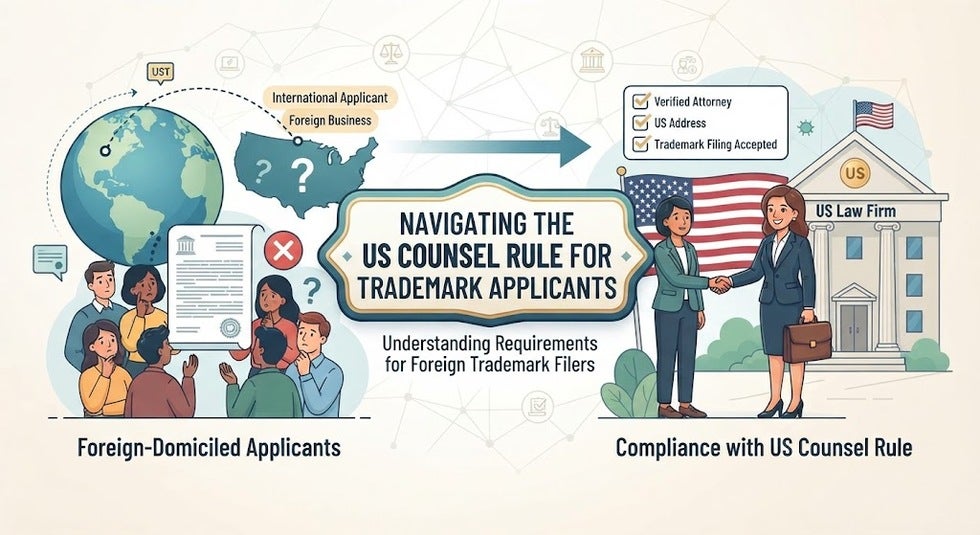
What Is the USPTO's US Counsel Rule for Foreign Trademark Applicants?
Quick answer: The US counsel rule requires trademark applicants, registrants, and parties whose domicile is outside the United States to be represented by an attorney licensed to practice law in the US. Effective since August 3, 2019, this USPTO rule applies to filing new applications, responding to office actions, filing maintenance documents, and participating in Trademark Trial and Appeal Board (TTAB) proceedings. All such filings are required to be submitted by a US-licensed attorney on behalf of the applicant or registrant.
If you're a business owner or brand outside the United States looking to protect your trademark in the US market, this rule affects you directly. Understanding it upfront can save you from filing delays, application refusals, or wasted fees. This article breaks down what the US counsel rule means, who it applies to, and what foreign-domiciled applicants and registrants need to do to stay compliant.
What Is the USPTO's US Counsel Rule?
The United States Patent and Trademark Office (USPTO) requires that any trademark applicant, registrant, or party to a TTAB proceeding whose domicile is located outside the United States be represented at all times by an attorney who is licensed to practice law in the US. This rule took effect on August 3, 2019, and applies across nearly every stage of the trademark process, from initial filing through registration maintenance.
The attorney representing a foreign-domiciled party must be an active member in good standing of a bar in a US state, the District of Columbia, or a US territory. Foreign attorneys, patent agents, and other non-attorney representatives, including those admitted to practice in Canada under prior reciprocity arrangements, generally cannot represent foreign applicants before the USPTO in trademark matters.
The USPTO introduced this requirement to improve the accuracy and quality of the trademark register. Before the rule, the agency saw a rise in inaccurate or fraudulent filings, largely tied to unauthorized practice of law and unqualified filing assistance for foreign applicants. Requiring US-licensed counsel gives the USPTO a reliable point of accountability for every foreign-owned application.
Who Does the US Counsel Rule Apply To?
The rule applies to any applicant, registrant, or party whose domicile is outside the United States. The USPTO defines domicile as the applicant's permanent legal residence, not simply a mailing address or business location.
For individuals, domicile means the country where the person permanently resides. For businesses, domicile refers to the location of the entity's principal place of business, meaning its headquarters, not a branch office or subsidiary located elsewhere.
This distinction matters. A company headquartered in Germany with a US subsidiary is still considered foreign-domiciled for purposes of this rule unless the US subsidiary itself owns the trademark application and truly operates as the entity's principal place of business.
The rule applies at every stage of the process, including:
- Filing a new trademark application
- Responding to office actions
- Filing a Statement of Use or Amendment to Allege Use
- Filing renewal and maintenance documents, such as Section 8 and Section 15 declarations
- Participating in opposition or cancellation proceedings before the TTAB
Why Does the US Counsel Rule Matter for Foreign Applicants?
For foreign-domiciled businesses, the practical impact is straightforward: you cannot file or maintain a US trademark application on your own, no matter how strong your business or brand is in your home country.
Failing to comply with the rule can lead to delays, procedural refusals, or missed deadlines that jeopardize your trademark rights. Since US trademark rights are generally based on use in commerce (with limited exceptions for foreign applicants relying on a home-country registration under Section 44 or an international registration under the Madrid Protocol), losing time in the application process can have real consequences for your brand protection strategy.
Choose US counsel early if you're planning to expand your brand into the US market. Retaining a qualified US-licensed trademark attorney from the outset helps you avoid procedural pitfalls and positions your application for a smoother path to registration.
What Should Foreign-Domiciled Applicants Do to Comply?
Complying with the US counsel rule involves a few key steps:
1. Confirm your domicile status. If your business's principal place of business or your personal residence is outside the United States, the rule applies to you, even if you have US operations or ties.
2. Retain a US-licensed attorney. The attorney must be in active good standing with a state bar, the District of Columbia, or a US territory. Verify this credential before engaging counsel, since the USPTO may reject filings submitted by unauthorized representatives.
3. Provide accurate attorney information. The USPTO requires attorneys to confirm their bar membership information as part of the filing process. Errors or omissions here can delay examination.
4. Maintain representation throughout the application lifecycle. The requirement doesn't end once your trademark is registered. You'll need US counsel for maintenance filings, renewals, and any enforcement or opposition proceedings that arise later.
5. Understand the difference between agents and attorneys. Trademark agents, even those licensed in other jurisdictions, cannot represent foreign applicants before the USPTO. Only US-licensed attorneys satisfy the rule.
Protecting Your Brand in the US Starts with the Right Counsel
The US counsel rule reflects a broader principle in US trademark law: proper legal representation protects both applicants and the integrity of the trademark register. For foreign-domiciled businesses and individuals, this means partnering with a US-licensed trademark attorney isn't a bureaucratic hurdle. It's a necessary step toward securing enforceable trademark rights in one of the world's largest markets.
If your business is domiciled outside the United States and you're considering filing a trademark application, or if you already hold a US registration and need to file maintenance documents, working with experienced US trademark counsel ensures your filings meet USPTO requirements and your brand stays protected.
Frequently Asked Questions
Does the US counsel rule apply to companies with a US office?
It depends on where the company's principal place of business is located. If your headquarters is outside the United States, the rule still applies even if you operate a branch office, subsidiary, or sales team within the US.
Can a foreign attorney represent me before the USPTO?
No. Only attorneys licensed and in active good standing with a US state bar, the District of Columbia, or a US territory can represent foreign-domiciled applicants and registrants before the USPTO.
What happens if I file a trademark application without US counsel?
The USPTO will generally issue an office action requiring you to appoint qualified US counsel before your application can proceed. Failure to respond within the required deadline can result in your application being deemed abandoned.
Does the rule apply after my trademark is already registered?
Yes. Foreign-domiciled registrants need US counsel for post-registration filings, including Section 8 declarations of use, Section 15 declarations of incontestability, and renewal applications.
Is the US counsel rule the same for Madrid Protocol filings?
Foreign applicants filing through the Madrid Protocol are still subject to the US counsel rule once their international registration is extended to the United States. US counsel is required for responding to any USPTO office actions and maintaining the resulting US registration.
If you are a non-US domiciled business owner needing assistance with a US trademark application or registration, send us an email or sign up for a consultation! Our law firm has extensive experience representing non-US trademark owners before the USPTO.

