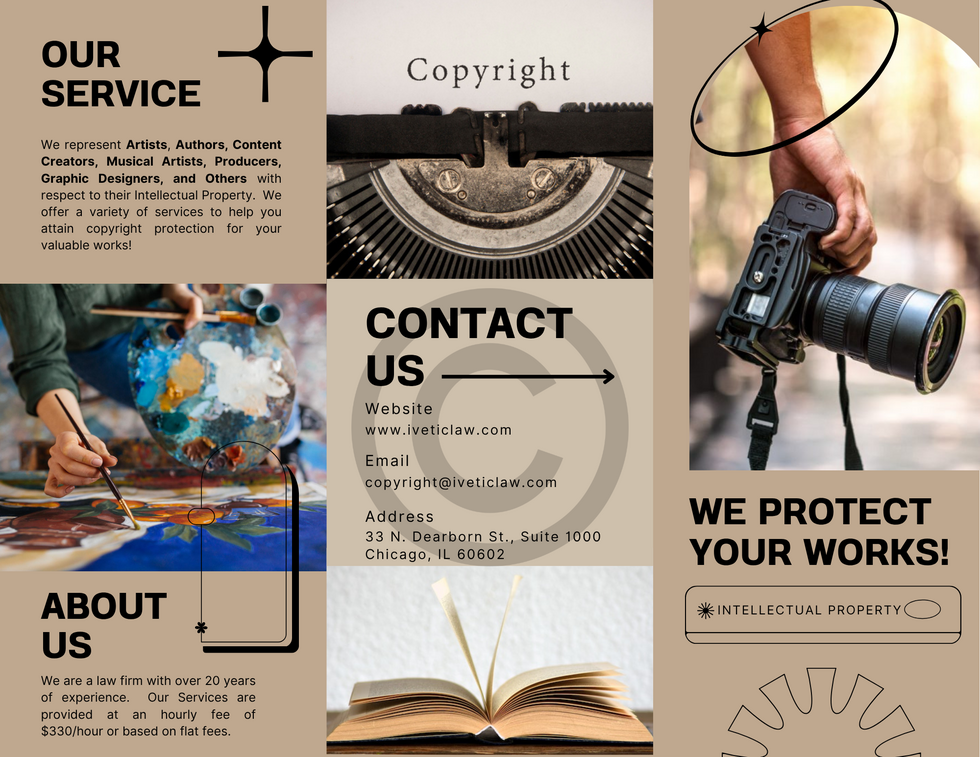
What Is Copyright Registration?
You just finished writing a song, novel, recording a new album, or coding a groundbreaking app. You have poured hours of sweat, hard work and creativity into this finished project. Naturally, you want to make sure nobody else can claim it as their own or profit from your hard work without permission.
This brings up a common question for many creators: Do I need to register my copyright?
Technically, your work is protected the moment you create it and fix it in a tangible form (that is often called a "common-law" copyright or a "poor man's" copyright). However, relying solely on this automatic protection can leave you vulnerable if someone actually steals your work.
This article explains what copyright registration is, why it is a critical step for serious creators, and how the process works in the United States.
The Basics: What Is Copyright?
Before diving into registration, we need to clarify what copyright actually is. Copyright is a type of intellectual property that protects original works of authorship.
When you create something original—like a book, song, painting, photograph, or software code—and put it into a fixed form (like writing it down or saving it on a hard drive or painting it on a canvas), you automatically own the copyright to that work. You are already at that time entitled to use the copyright symbol (and as a general rule, you should use that symbol).
As the copyright owner, you have the exclusive right to:
- Reproduce the work
- Prepare derivative works (like a movie based on your book)
- Distribute copies (by way of sale, rental, lease, or lending)
- Perform the work publicly (in the case of literary, musical, dramatic, and choreographic works, pantomimes, and motion pictures and other audiovisual works)
- Display the work publicly (in the case of literary, musical, dramatic, and choreographic works, pantomimes, and pictorial, graphic, or sculptural works, including the individual images of a motion picture or other audiovisual work)
If you have these rights automatically, why bother with registration? The answer lies in enforcement (and the available damages you can recover).
What Is Copyright Registration?
Copyright registration is a legal formality. It creates a public record of your ownership. In the United States, you register your work with the U.S. Copyright Office.
Think of it like the title to a car. You might possess the car and drive it every day, but the title is the official government document that proves to the world that you own it. Registration is your "title" for your creative work.
Without registration, you have rights, but they are much harder to defend.
Why Registration Matters: The Benefits
While registration is voluntary, it provides significant legal advantages that automatic protection does not. If you intend to monetize your work or are worried about infringement, these benefits are essential.
1. You Cannot Sue Without It
This is the most critical benefit. In the United States, you generally cannot file a lawsuit for copyright infringement in federal court unless your work is registered.
Imagine someone copies your YouTube video and puts it up on their own page, stealing viewers from you. You send a cease-and-desist letter, but they ignore it. If you want to take them to court to stop them, the judge will require proof of registration before the case can proceed.
Or, imagine that you have a photograph, and someone else copies and uses it on their page without your permission. You send a DMCA notification to get it taken down, but the other party initiates a Counter DMCA notice. At that point, unless you provide proof that you have initiated a lawsuit in federal court, their provider is obliged to reinstate their webpage with the image. Again, at that stage, you can initiate a federal lawsuit only if that image is registered with the Copyright Office.
So basically, in every single instance where you need to enforce your rights to your works, prior registration with the Copyright Office is a must.
2. Statutory Damages and Attorney's Fees
If you register your work before the infringement happens (or after infringement but within three months of publication of your work), you become eligible for "statutory damages." Statutory damages can be quite significant and often make the difference between a lawsuit no lawyer will take and one that lawyers are eager to take and prosecute on your behalf.
Proving exactly how much money you lost because someone stole your photo or song can be incredibly difficult. Statutory damages allow a court to award you a set amount of money—ranging from $750 to $150,000 per work—without you having to prove actual financial loss.
Additionally, timely registration allows you to ask the court to make the infringer pay your legal fees. Without this, even if you win, the cost of the lawsuit might be higher than what you recover.
3. Presumption of Ownership
If you register within five years of publication, the court presumes that your copyright is valid and that all the facts stated in your certificate are true. This shifts the burden of proof to the infringer. Instead of you having to prove you own it, they have to prove you don't.
4. Customs Protection
Registered copyrights can be recorded with the U.S. Customs and Border Protection. This allows customs officials to stop infringing copies (like pirated DVDs or knock-off merchandise) from entering the country.
What Can (and Cannot) Be Registered?
The U.S. Copyright Office accepts a wide range of creative works.
Commonly Registered Works:
- Literary Works: Novels, poems, essays, computer code.
- Visual Arts: Paintings, photographs, sculptures, maps, architectural plans.
- Performing Arts: Scripts, musical compositions, choreography.
- Sound Recordings: The actual audio recording of a song or podcast.
- Motion Pictures: Movies, TV shows, video games.
What You Cannot Register:
- Ideas: You can protect the expression of an idea (the text of your book), but not the idea itself (a story about a wizard boy).
- Titles and Short Phrases: Names, slogans, and titles generally cannot be copyrighted (though they might be eligible for trademark protection).
- Facts and Data: You cannot copyright historical facts or a list of ingredients, though you might be able to protect the unique way you organize or express them.
The Registration Process: A Step-by-Step Guide
Registering a copyright is relatively straightforward, though it requires attention to detail. Most people can complete the process online.
Step 1: Visit the eCO System
The Electronic Copyright Office (eCO) is the online portal for registration. It is faster, cheaper, and allows for online status tracking compared to paper applications.
Step 2: Complete the Application
You will need to create an account and select the correct form for your type of work (e.g., "Standard Application" for a single work by a single author). The application asks for:
- Title of the work
- Author information
- Claimant information (usually the author, but could be a company)
- Publication details (has it been published yet? If so, when?)
- What is being claimed
- Is anything being excluded (ie. if your work has parts someone else created)
Step 3: Pay the Fee
As of 2026, the standard filing fee for a basic online claim is typically between $45 (single work and single author, not work for hire) and $65 (standard registration) per application. A group registration of unpublished works is $85. The registration for a group of newspapers is $95. Other types of registrations have different fees. Fees are subject to change, so always check the current schedule on the Copyright Office website. (accessible at - https://www.copyright.gov/about/fees.htm)
Step 4: Submit the "Deposit"
You must submit a copy of the work you are protecting. For many works, you can upload a digital file (PDF, MP3, JPG) directly through the portal.
If you are registering a published book or a physical product, you may need to mail physical copies to the Library of Congress. These copies are generally not returned.
Step 5: Wait for Processing
The Copyright Office receives hundreds of thousands of applications. Processing times vary widely. It can take anywhere from one month to over a year to receive your certificate. However, the effective date of registration is the day the Copyright Office receives your complete application, payment, and deposit—not the day they finish reviewing it.
When Should You Consult a Lawyer?
While many creators handle simple registrations themselves, intellectual property law can get complicated quickly. You should consider speaking with an intellectual property attorney if:
- The work has multiple authors: Determining ownership percentages and rights can be tricky.
- The work contains third-party material: If your work uses samples, quotes, or elements created by others, you need to navigate "fair use" and licensing carefully.
- You are registering software: Protecting code often requires redacting trade secrets, which requires specific legal knowledge.
- You suspect infringement: If someone is already stealing your work, do not try to handle the legal battle alone.
Conclusion
Copyright registration is a powerful tool for protecting your creative legacy. It transforms your automatic rights into enforceable legal power. By taking the time to register your work, you ensure that you have the legal standing to defend your intellectual property and the potential to recover damages if your rights are violated.
Don't leave your hard work unprotected. If you have created something valuable, take the next step to secure it.