
Understanding "Dead" Trademark Status: What Does It Mean for Your Brand?
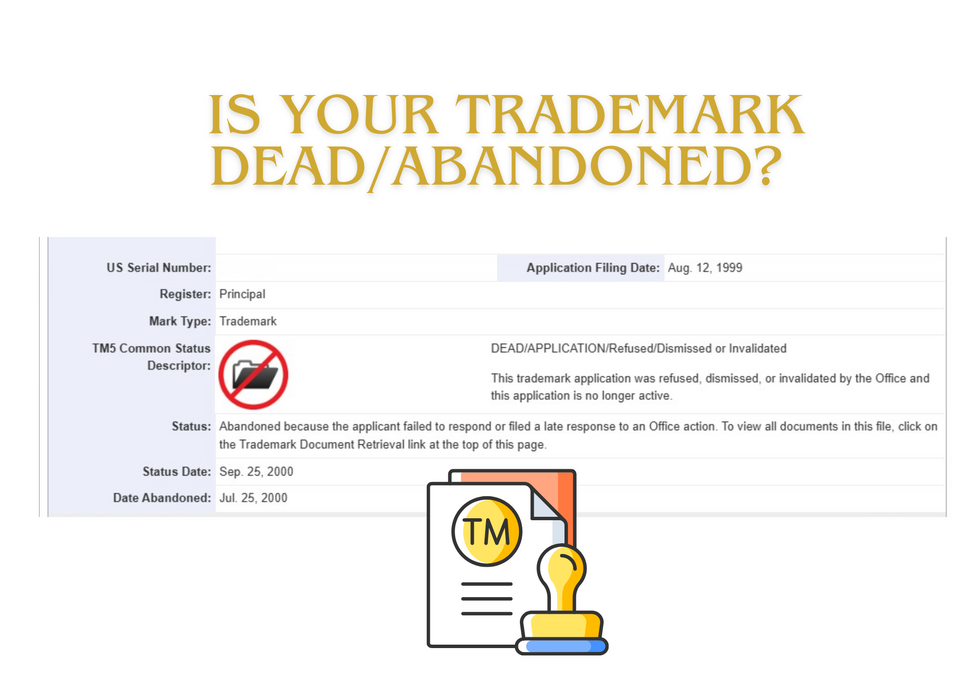
By now, everyone likely knows the importance of having a federal trademark registration at the USPTO for your brand. But the process can be confusing to someone who is not familiar with the rules and procedures of the USPTO. Plus, the process takes a long time. It is easy to lose sight of an application, a deadline. You check Google, and perhaps find our law firm's blog (or that of another), which tells you that you can check the status of your trademark application or registration on the USPTO's TSDR database. You log into the USPTO's TSDR database to check on your intellectual property, only to see a label next to your mark that stops you in your tracks: DEAD.
It's an alarming word to see associated with one of your most important your business assets. But before you panic, take a deep breath. While a "dead" status on a trademark file is serious, it doesn't always mean the end of the road for your branding efforts. It does, however, signal a critical legal status that requires immediate understanding.
This guide breaks down exactly what a dead trademark file status means, why it happens, and what you can do about it.
What is a "Dead" Trademark Status?
In the simplest terms, a "dead" trademark status means that the United States Patent and Trademark Office (USPTO) is no longer processing the application or maintaining the registration. The file is effectively inactive. The TSDR entry for that trademark will typically also have a second word that identifies if that file was abandoned or cancelled.
When a trademark is dead (regardless of whether it is "cancelled" or "abandoned"), you cannot use the ® symbol with a dead trademark.
However, it is crucial to understand the nuance here. A dead status at the federal level means you have lost your federal registration rights. It does not automatically mean you have lost your common law rights. If you are still actively using the logo or name in commerce, you may still have some legal claim to it within your specific geographic area, even if the federal paperwork has lapsed. Likewise, you may still be able to file a new application to start from the beginning and seek federal registration.
Why Do Trademarks "Abandon"?
Trademark applications don't just expire randomly. A file usually moves to dead - abandoned status because of a specific failure in the application process. Here are the most common culprits:
1. Failure to Respond to Office Actions
During the application process, a USPTO examining attorney might send an "Office Action." This is sometimes also referred to as a Preliminary Refusal. This is a formal letter raising a problem with your application—perhaps your logo is too similar to an existing one, or the description of your goods is too vague. Office Actions can be non-substantive in nature (ie. technical/minor) or they can be substantive in nature. For more information on the differences between the two types of Office Actions, check out our blog articles on those topics - https://www.iveticlaw.com/understanding-what-is-a-substantive-office-action-refusal-and-how-to-overcome-it and https://www.iveticlaw.com/post/non-substantive-office-action
You have a strict deadline (usually three months, extendable to six if you pay for an extension) to respond. If you miss this deadline, the USPTO assumes you have given up. They will mark the application as abandoned, and the status becomes dead.
2. Failure to File a Statement of Use
Another common culprit for a trademark's abandonment is after you are issued a Notice of Allowance on an "intent-to-use" trademark application. The Notice of Allowance gives you a 6-month period to make an additional filing with the USPTO to prove that you have commenced use of your trademark in commerce. If you file sufficient proof (called a Statement of Use) within that time period, your application will mature into a full federal trademark registration. You can extend the 6-month period by timely filing an extension (and paying the fee) for up to 36 months from the Notice of Allowance. However, if you fail to file either a Statement of Use or an Extension before the expiration of that 6-month period, your application will be abandoned. For more information about Notices of Allowance - see our blog at - https://www.iveticlaw.com/got-a-notice-of-allowance-on-your-trademark-application-great-but-now-what
3. Losing a Dispute
If another company challenges your trademark application (through an opposition proceeding) and wins (or if you fail to respond in time), the Trademark Trial and Appeal Board (TTAB) may sustain the opposition and cause your application to be abandoned.
Why Do Trademarks get "Cancelled"?
Once registered at the USPTO, a Federal Trademark can last a long time, so long as you keep up with required maintenance and renewal filings. However, if you fail to file or file incorrectly, your registration can and will be cancelled by the USPTO.
1. Failure to File Maintenance/Renewal Documents
Getting your trademark registered is not a "one and done" event. You must prove you are still using the mark to keep it alive.
Specific filings are required between the fifth and sixth year after registration, and again between the ninth and tenth year (and every ten years after that). These are known as Section 8 and Section 9 declarations. If you forget to file these documents or pay the associated fees, the registration will be cancelled, and the status will change to dead.
If you are interested in finding out more information about renewal of trademark registrations, you may want to check out another of our blog articles - https://www.iveticlaw.com/understanding-sec-8-trademark-renewal-deadlines
2. Express Abandonment
Sometimes, a business owner voluntarily chooses to stop the process. Maybe you rebranded, or you decided the legal fees to fight an Office Action weren't worth it. You can file a request for "express abandonment," which officially kills the application.
This most often comes about if you have gotten a cease and desist from someone for infringing on their priority rights.
3. Losing a Dispute
If another company challenges your trademark (through a ancellation proceeding) and wins, the Trademark Trial and Appeal Board (TTAB) may order your registration cancelled.
The Implications of a Dead Trademark
The consequences of a dead status depend heavily on who you are in the equation: the original owner or a competitor.
For the Original Owner
If this was your trademark, a dead status is a significant vulnerability.
- Loss of National Protection: You lose the presumption of ownership nationwide.
- Open Season: Because your federal placeholder is gone, other businesses might try to register similar names or logos.
- Enforcement Issues: It becomes much harder (and more expensive) to sue copycats in federal court without a live registration.
For Competitors and New Applicants
For someone looking to register a new brand, finding a "dead" trademark in the database can be good news—but proceed with caution.
- Availability: A dead status generally means the specific block on that name is removed from the federal register. The USPTO will not cite a dead mark against a new application.
- The "Zombie" Risk: Just because the USPTO status is dead doesn't mean the business is dead. If the original owner is still using the name, they still have common law rights. If you try to use their "dead" mark, they could still sue you for unfair competition or trademark infringement.
Can You Revive a Dead Trademark?
The answer is: sometimes, but the window of opportunity is small.
Reviving an Abandoned Application
If your application went dead because you missed a deadline for an Office Action, you might be able to file a Petition to Revive.
- Timing: You typically must file this petition within two months of the USPTO issuing the Notice of Abandonment.
- Reasoning: You usually have to state that the delay was "unintentional."
- Cost: There is a significant fee associated with this petition.
Reinstating a Cancelled Registration
If your registered trademark is dead because you missed a maintenance filing (like the 10-year renewal), revival is much harder. Once the grace period for renewal has passed, the registration is usually gone for good.
In this scenario, your only option is often to start over completely. You would need to file a brand new application, pay all new fees, and undergo the examination process again. The risk here is that new trademarks may have been registered in the interim that could now block your new application.
Taking Action: What Should You Do Now?
Intellectual property law is deadline-driven and unforgiving of mistakes. A "dead" status is a red flag that requires immediate professional attention.
If you are the owner of a dead mark:
Do not assume you can just keep using the mark without consequence. You need to assess if revival is possible or if a new application is necessary to protect your brand value.
If you want to use a dead mark:
Do not assume the name is free to take. You need a comprehensive clearance search to ensure the previous owner hasn't retained common law rights that could lead to a lawsuit.
Protect Your Brand's Future
Navigating the USPTO database and understanding the nuances of trademark status can be overwhelming. Don't leave your brand's most valuable assets vulnerable to expiration or cancellation.
Whether you need to revive a lapsed application, file a new registration, or check the safety of a potential brand name, we are here to help.
Contact our firm today for a consultation. Let's ensure your trademark remains as alive and active as your business.

