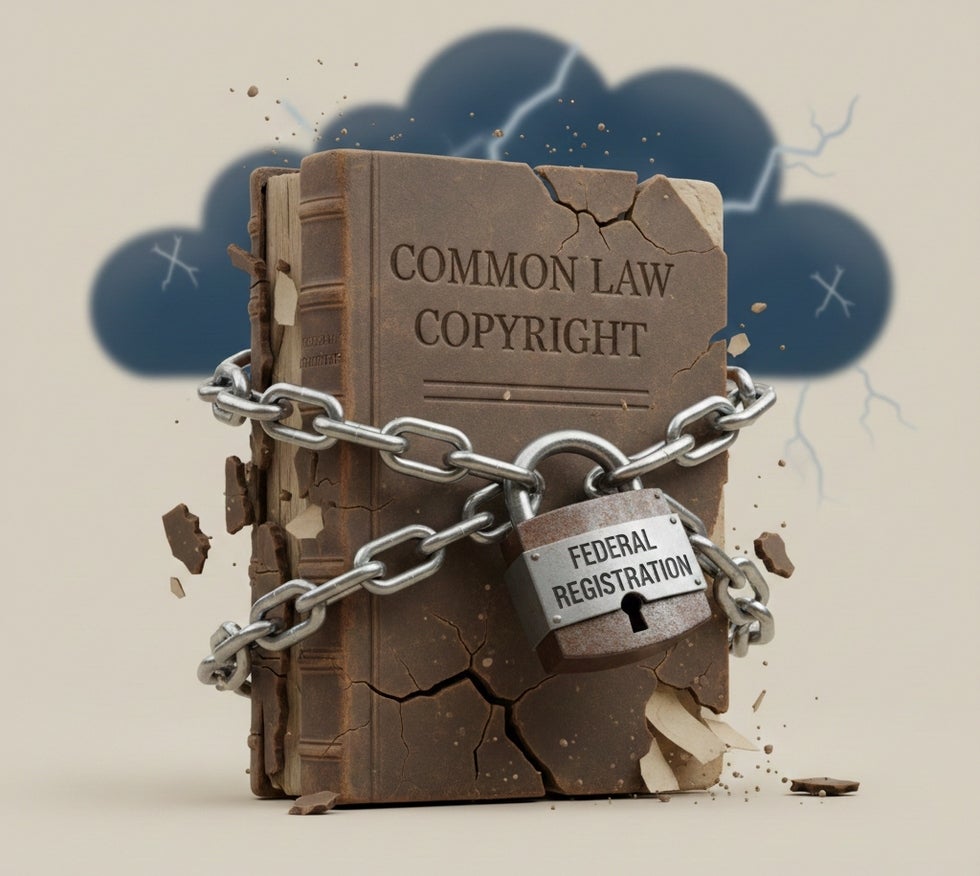
Is "Common Law" Copyright Enough?
Many creators question whether they really need to go through the hassle and expense of registering their valuable copyright with the US Copyright Office. While it is true that you technically own the copyright the moment your pen leaves the paper or your fingers leave the keyboard, this automatic protection—often called "common law copyright" (or a "poor man's" copyright) —is surprisingly weak when put to the test.
If you are serious about protecting your intellectual property, relying on implicit rights is a dangerous gamble. This article explains the significant limitations of unregistered copyrights and why taking formal steps to protect your work is the only way to secure real legal leverage.
What Is Common Law Copyright?
In the United States, copyright protection attaches to a work as soon as it is "fixed in a tangible medium of expression." This means that the moment you write a song, paint a picture, or draft a manuscript, you have rights. You do not need to file paperwork to be the owner of that work. This is what legal professionals refer to as common law copyright.
Under this automatic protection, you have the exclusive right to:
- Reproduce the work.
- Prepare derivative works.
- Distribute copies.
- Perform or display the work publicly.
However, having rights and being able to enforce them are two very different things. Common law copyright is a shield made of paper. It exists, but it offers very little protection against a serious infringement attack.
The Weakness of Relying on "Automatic" Protection
The biggest misconception among artists and business owners is that common law copyright gives them the power to sue for infringement. In reality, the U.S. Supreme Court has ruled that you cannot file a copyright infringement lawsuit in federal court until you have actually registered your work with the U.S. Copyright Office.
Without registration, your common law rights are largely theoretical. Here are the specific weaknesses you face when you rely solely on automatic protection.
1. You Cannot Sue in Federal Court
This is the most critical limitation. If someone steals your work today and you haven't registered it, you generally cannot drag them into a federal courtroom tomorrow. You must register the work first. This delay can be costly. By the time your registration is processed (which can take months), the damage to your brand or sales might already be irreversible.
2. You Lose Statutory Damages
If you register your work after an infringement occurs, you can only sue for "actual damages." Actual damages are often difficult to prove. You have to demonstrate exactly how much money the infringer made from your work or exactly how much money you lost. This is often a low number, making a lawsuit financially impractical.
If you register before infringement (or within three months of publication), you are eligible for "statutory damages." These can range from $750 to $30,000 per work, and up to $150,000 if the infringement was willful. You do not need to prove you lost a single penny to be awarded these damages.
3. You Pay Your Own Legal Fees
Litigation is expensive. Without timely registration, you generally cannot recover attorney's fees from the infringer. This means even if you win your case on the basis of actual damages, your legal bills might exceed the amount you win. This reality often forces unregistered copyright owners to walk away from theft because they simply can't afford to fight it.
The Power of the Copyright Symbol (©)
Even if you haven't registered your work yet (though you should), using the copyright symbol is a critical first line of defense. It gives notice to the world that you claim ownership and serves as a "No Trespassing" sign for your intellectual property.
Proper notice consists of three elements:
- The symbol: © (or the word "Copyright" or the abbreviation "Copr.").
- The year: The year of first publication.
- The owner: The name of the copyright owner.
Example: © 2026 Jane Doe LLC.
Why Use the Symbol?
It defeats the "Innocent Infringement" defense.
If you sue someone for using your work, they might claim they didn't know that it was copyright-protected. This is the "innocent infringer" defense, and it can significantly reduce the damages they have to pay you. If your work clearly displays the © symbol, this defense becomes invalid. The infringer cannot claim ignorance when the notice was right there on the page.
It acts as a deterrent.
Most theft is a crime of opportunity. People steal images or text from the internet because they think no one is watching or claiming ownership. A visible copyright notice signals that you are a professional, aware of your rights, and likely to defend them. It makes casual infringers think twice.
It clarifies ownership.
In the digital age, works get shared and reposted constantly. A watermark or a footer with your copyright notice ensures that no matter where your work travels, your name travels with it. This makes it easier for people who want to license your work to find you and pay you.
It strengthens legal claims. If an infringer removes or alters a copyright symbol or notice from your work, this act can provide an additional cause of action in a lawsuit. Under many copyright laws, the deliberate removal of a copyright notice can demonstrate willful infringement, potentially leading to enhanced damages awarded in a legal case. This not only reinforces the importance of including the symbol but also acts as a further deterrent to potential infringers.
Where to Place the Copyright Symbol
Placement matters. You cannot hide the notice in microscopic text and expect it to hold up in court. It must be placed in a way that gives "reasonable notice" to anyone viewing the work.
- Websites: Place it in the footer of every page. Ensure the year is current or includes a range (e.g., 2020–2026).
- Written Works (Books/Articles): Place it on the title page or the page immediately following it.
- Visual Art: Place it on the front or back of the canvas, or on the mount.
- Software: Include it in the code header and on the user interface during startup.
- Videos: Include it in the opening or closing credits.
For sound recordings, the symbol is slightly different. You should use the sound recording copyright symbol (℗) rather than the standard ©.
Moving From Common Law to Federal Protection
While using the symbol helps, it is not a substitute for registration. The symbol puts the world on notice; registration gives you the heavy artillery to enforce that notice.
The process of registration is straightforward but requires attention to detail.
- Application: You file a claim with the U.S. Copyright Office.
- Fee: You pay a filing fee (which is relatively low compared to the cost of litigation).
- Deposit: You submit a copy of the work you are protecting.
Once registered, the facts stated in your certificate are presumed true in court. This shifts the burden of proof. Instead of you having to prove you own the work, the infringer has to prove you don't.
Don't Leave Your Assets Vulnerable
Intellectual property is often the most valuable asset a modern business or creator owns. Relying on common law copyright is like leaving your front door unlocked because you live in a safe neighborhood. It might be fine for a while, but it offers zero protection when an intruder actually arrives.
If you have created software, written a book, designed a logo, or produced a significant body of work, do not rely on implicit rights. Use the copyright symbol on everything you release to the public. More importantly, take the step to formally register your work.
Registration converts your "paper shield" into actual armor. It opens the door to federal court, statutory damages, and the recovery of legal fees. It turns your creativity into a secure, enforceable asset.
If you are unsure whether your current portfolio is protected, or if you need assistance filing a registration for a complex work, consult with an intellectual property attorney. The cost of prevention is always lower than the cost of a lost lawsuit.