Confused About the "Fair Use" Exception in Copyright Law? A Guide
The following scenario happens alot. You are putting together a presentation, editing a video for YouTube, or writing a blog post. You find the perfect image, song clip, or quote to make your point. But before you hit "publish," a nagging question pops up: Am I allowed to use this?
Copyright law can feel like a minefield, especially to someone who is not legally trained. While creators deserve protection for their work, the law also recognizes that creativity often builds on the past. This is where the doctrine of "fair use" comes in. "Fair use" is an exception under copyright law. It serves as a critical safety valve in copyright law, allowing people to use protected works without permission in specific circumstances.
Understanding fair use is essential for creators, educators, and business owners alike. It empowers you to create without fear, but it also helps you respect the rights of others. This guide breaks down the basics of fair use, the four factors courts look at, and real-world examples to help you navigate these legal waters.
What Exactly Is Fair Use?
Fair use is a legal doctrine in the United States that promotes freedom of expression by permitting the unlicensed use of copyright-protected works in certain situations. It is found in Section 107 of the Copyright Act.
Think of it as an exception to the general rule. Generally, you need permission to use someone else's work (otherwise it is considered unauthorized, aka "infringement"). Fair use says, "Hold on, under these specific conditions, you don't need to ask."
However, fair use is not a black-and-white rule. It is very much a gray area. There is no magic number of words, seconds of a song, or percentage of an image that automatically qualifies as safe. Instead, fair use is determined on a case-by-case basis. If a dispute arises, a judge must analyze the specific facts of your situation to decide if your use was "fair."
The Four Factors of Fair Use
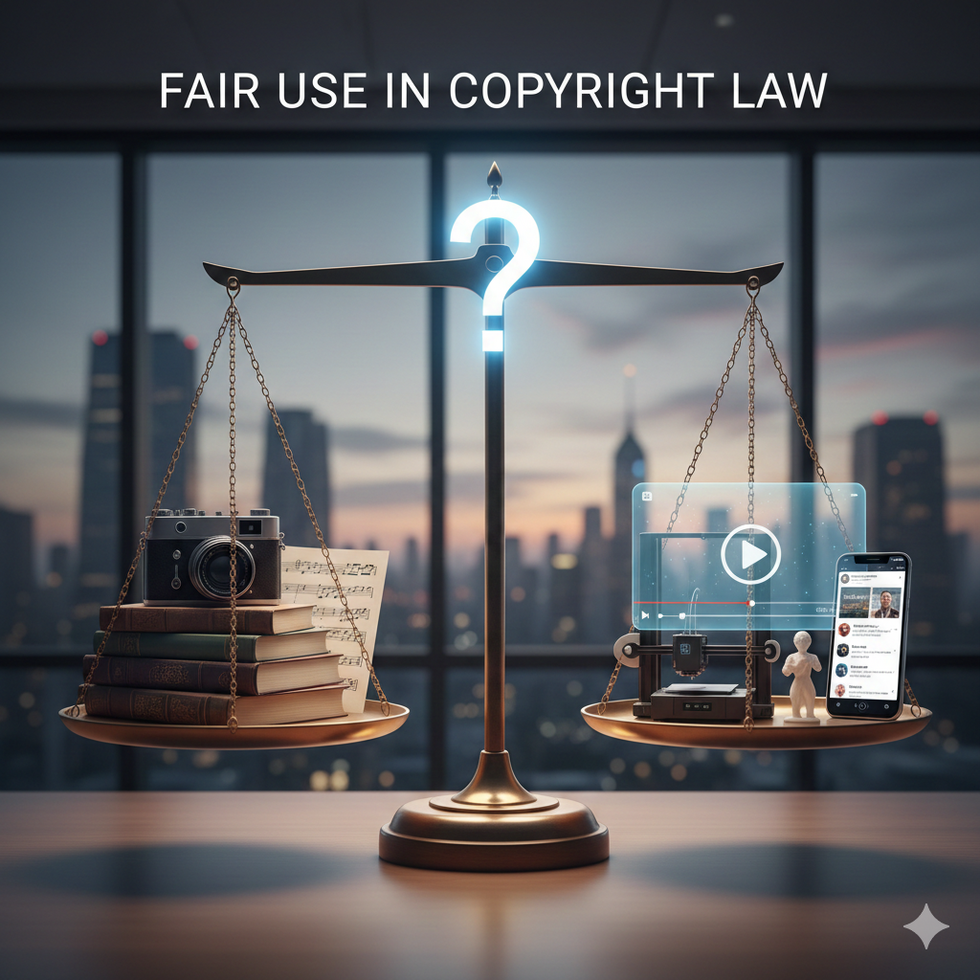
When courts decide if something qualifies as fair use, they balance four distinct factors. No single factor determines the outcome; they are weighed together.
1. The Purpose and Character of the Use
This is often the most significant factor. Courts look at how you are using the material.
- Transformative Use: Did you add something new? Did you change the purpose or character of the original work? If you use a clip from a movie to critique the acting (commentary) rather than just to entertain (copying), it is more likely to be fair use.
- Commercial vs. Non-Commercial: Is your use for a non-profit educational purpose, or are you trying to make money? Non-commercial uses generally lean more toward fair use, but making money doesn't automatically disqualify you.
2. The Nature of the Copyrighted Work
This factor looks at the original work you are using.
- Factual vs. Creative: Copyright law protects creative expression more strongly than factual information. Using a chart from a scientific report is more likely to be fair use than using a stanza from a famous poem or a scene from a fictional movie.
- Published vs. Unpublished: Authors have the right to control the first public appearance of their work. Using an unpublished manuscript is harder to justify as fair use than using a published book.
3. The Amount and Substantiality of the Portion Used
How much of the original work did you take?
- Quantity: Generally, the less you use, the better. Quoting a paragraph from a book is safer than copying a whole chapter. However, there is not magic number as to how much you are allowed to use (and how much gets you in trouble).
- Quality: This is the tricky part. Even if you take a small amount, it might not be fair use if you take the "heart" of the work. For example, using the most famous 10-second guitar riff from a hit song might weigh against fair use because that riff is the most recognizable and valuable part of the track.
4. The Effect on the Potential Market
Does your use hurt the original creator's ability to make money?
- If your new work serves as a substitute for the original, it likely isn't fair use. For instance, if you scan a textbook and put it online for free, students won't buy the original book. That directly harms the market.
- However, a negative review that uses clips to show why a movie is bad might hurt ticket sales, but that is not considered a copyright harm. That is just the result of criticism, which fair use protects.
Common Examples of Fair Use
While every case is unique, certain categories of use are often protected.
Commentary and Criticism
This is one of the strongest arguments for fair use. If you are quoting a book to review it, or using a clip from a news broadcast to analyze the reporting, you are likely on solid ground. This allows critics to do their jobs without needing permission from the people they are criticizing.
Parody
Parody involves using a work to make fun of that specific work. Because a parody needs to mimic the original to be recognizable, courts often grant significant leeway here. A famous example is "Weird Al" Yankovic, though he usually asks for permission anyway to maintain good relationships. Note that satire (using a work to make fun of something else, like society in general) has less protection than parody. If relying on parody as fair use, keep in mind what we said earlier about quantity and quality. That means that the more a parody relies on the original work instead of adding significant new meaning, the less likely that it will be able to qualify as fair use.
News Reporting
Journalists can often use excerpts of copyrighted material to report on current events. If a politician gives a speech, news outlets can play clips of that speech without infringing copyright.
Teaching and Education
Teachers have specific protections that allow them to use copyrighted materials in the classroom. Handing out a copy of a relevant article to students for a class discussion is often considered fair use. However, creating a digital coursepack of readings that replaces a textbook usually is not.
Myths About Fair Use
There is a lot of misinformation online about how copyright works. Let's debunk a few common myths:
- Myth: "I gave credit to the artist, so it's fair use."
-
- Fact: Attribution is polite and ethical, but it does not protect you from copyright infringement. You can still be sued even if you link back to the source.
- Myth: "I'm not making any money, so it's fine."
-
- Fact: While non-commercial use is a factor, it is not a "get out of jail free" card. If you distribute a free copy of a movie, you are hurting the market value, regardless of your profit.
- Myth: "I only used 10 seconds, so I'm safe."
-
- Fact: There are no hard-and-fast rules about duration or word count. It all depends on the four factors mentioned above.
When in Doubt, Ask for Help
Navigating fair use can be tricky. It is a balancing test, not a checklist. What works for a movie review might not work for a corporate training video. The consequences of getting it wrong can be expensive, ranging from takedown notices to costly lawsuits.
If you are planning to use a substantial amount of copyrighted material, or if your project has a high commercial value, relying on a guess isn't enough.
Do you have questions about specific content you want to use?
Don't risk your project or your business. Contact our team today to schedule a consultation. We can review your specific situation and help you understand your rights and risks.